The deep sea and the things that live there
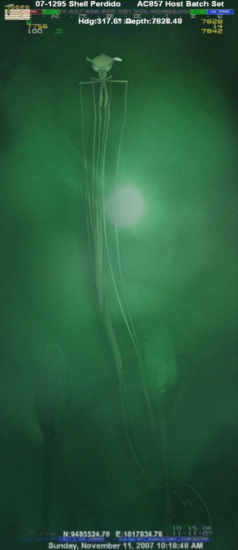
Magnapinna big fin squid
Shell Oil company caputured the elusive big fin squid on video using its remotely operated submersible at a depth of 2.3 KM (1.5 miles). Very little is known about these squids, scientists belive that the bigfin squid drags its tentacles along the seafloor and grabbing edible organisms off the floor. Estimates based on video evidence put the total length of the largest specimens at 8 metres (26 ft) or more.
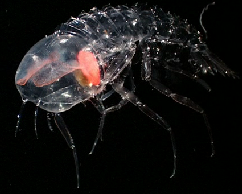
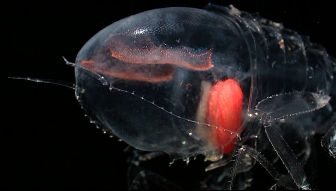
Giant Amphipod
They have been found at depths of 500 m. It has a completely transparent body, with the exception of its stomach and its compound eyes. The eyes occupy the entire top of its head, and the retinas can be seen as a thin layer of red in the otherwise clear head.
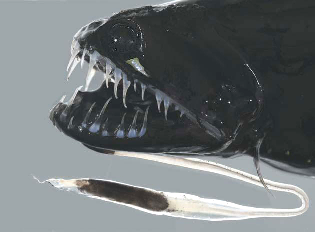
Dragonfish
The deep sea dragonfish is a ferocious predator in spite of its small size. The dragonfish has a long barbel attached to its chin. This barbel is tipped with a light-producing organ known as a photophore. These fishes are sexually dimorphic (the males and females look different). Dragonfishes live in deep ocean waters at depths of up to 1500 m (5000 feet).
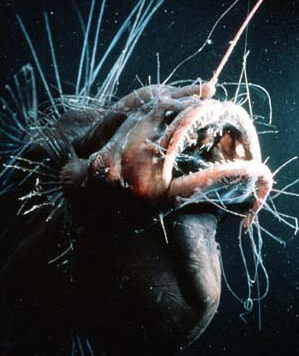
Hairy Angler
The hairy angler is the size of a beach ball and its body is covered in long antennae designed to pick out the movements of any prey foolish enough to venture close to its terrifying teeth.
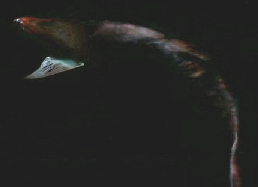
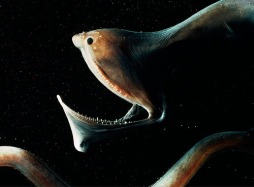
Gulper eel
A gulper eel engulfs its prey in its huge, pelicanlike mouth. It can unhinge its enormous jaws and stretch its stomach to consume a fish as big as itself. They are generally black in color, and can grow to lengths of 2 m (6.5 feet). They have been found at depths of 1,800 m (6,000 feet). Their tails are tipped by a luminous bulb-shaped organ.
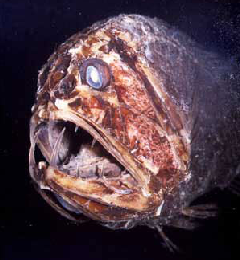
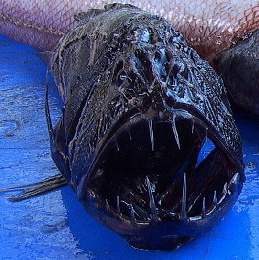
Fangtooth
While understandably named for their disproportionately large, fang-like teeth and unapproachable visage, fangtooths are actually quite small and harmless to humans. They are more commonly found between 200 - 2,000 metres (660 - 6,560 feet). Fangtooths are known to be robust when compared to many other deep-sea fish; they have been kept alive for months in aquariums despite conditions which are significantly different from their natural habitat.
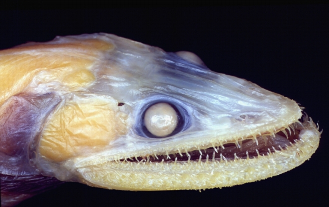
Bathysaurus
It is also called as deepsea lizardfish. The strong thick pelvic fins probably serve as props when the fish is resting on the bottom waiting for prey. Feeds primarily on fish. They have been found at depths of 600 m to 3500 m.
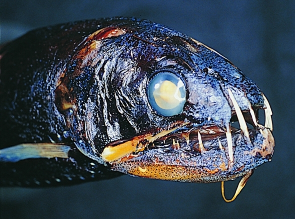
Astronesthes
Astronesthes also called as snaggletooth is black with purplish luminous areas on the side of the body. It has an elogate, slightly compressed body that lacks scales. It grows to 28cm in standard length.
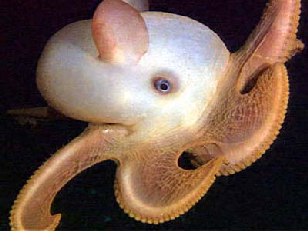
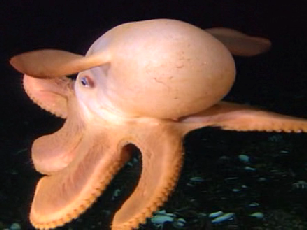
Deep Sea Octopus
The deep sea octopus also called as Dumbo, is equipped with large fins (which may resemble mammalian ears) to help it swim.
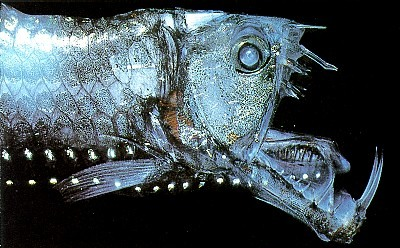
Viperfish
Few fish are more grotesque-looking than the viperfish. The viperfish grows to between 12 and 24 inches in length. Viperfish's teeth are so large in fact that they do not fit inside its mouth. The viper is thought to use these sharp teeth to impale its victims by swimming at them at high speeds. Vipers have a hinged skull, which can be rotated up for swallowing large prey.
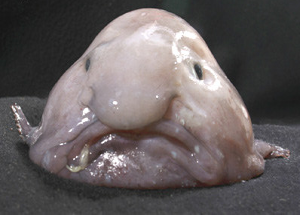
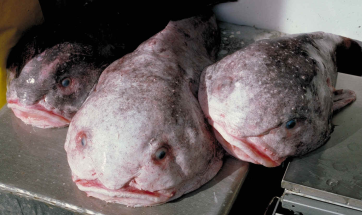
Blobfish
Blobfish are found at depths where the pressure is several dozens of times higher than at sea level, which would likely make gas bladders inefficient. To remain buoyant, the flesh of the blobfish is primarily a gelatinous mass with a density slightly less than water; this allows the fish to float above the sea floor without expending energy on swimming.
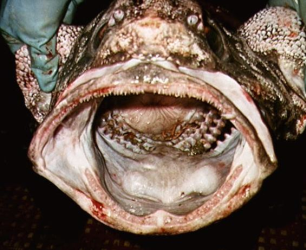
Giant grenadier
Grenadiers or rattails are generally large, brown to black gadiform marine fish of the family Macrouridae. This species is usually found living just above the bottom of the ocean. Its length is up to 2.1 m. They swim slowly over the sea bed searching for live prey, as well as carcasses to eat.
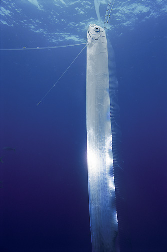
Oarfish
The common name oarfish is presumably in reference to either their highly compressed and elongated bodies or the shape and use of their pelvic fins. The occasional beachings of oarfish after storms, and their habit of lingering at the surface when sick or dying, have given oarfish a place in maritime folklore as the probable source of many sea serpent tales.
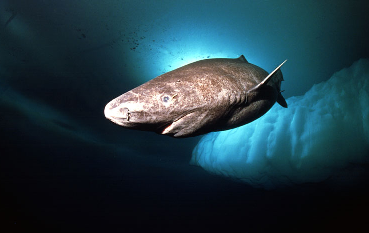
Greenland Sleeper Shark
The size of the Greenland shark is impressive; it is so large, in fact, that its record is comparable to (and may exceed) that of the great white shark. Greenland sharks are deep-water sharks, living at depths up to 2,000 m (1.24 mi). This shark frequently has a relationship with a parasitic copepod, that attaches itself to the cornea of the eye and feeds on the shark's corneal tissue.
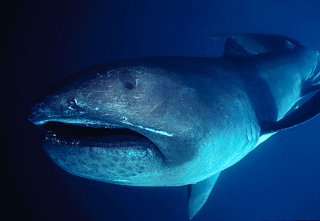
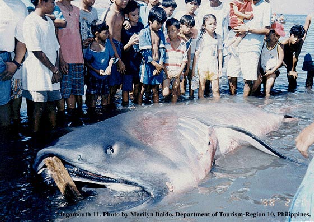
Megamouth Shark
The megamouth shark is a filter feeder, and swims with its enormous mouth wide open, filtering water for plankton and jellyfish. Megamouth has luminous organs that give off a glow around its lips. Scientists think this may be to tempt tiny creatures, such as plankton or fish into its mouth. Megamouths are very large sharks, with the largest specimen to date reaching 4.8 m (16 ft) and 1 tonne (2,205 lb).
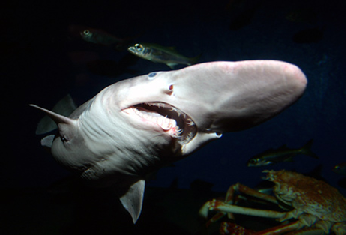
Goblin Shark
The most distinctive characteristic of the goblin shark is the unorthodox shape of its head. Up to 25% of the goblin shark's body weight can be its liver. It is currently not understood why the shark has such a large liver. In 2003, more than a hundred goblin sharks were caught off the northwest coast of Taiwan, an area in which they have previously not been found. Reportedly, the sharks were caught a short time after an earthquake occurred in the area.
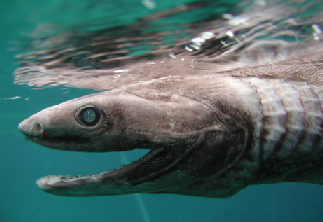
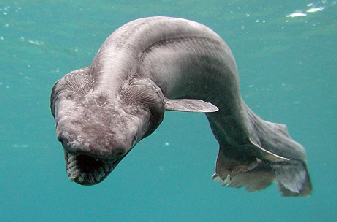
Frilled Shark
The frilled shark is referred to as a "living fossil" because it is a primitive species that has changed little since prehistoric times. Superficially, the frilled shark resembles a dark brown or grey eel, but the six gill slits identify it as a shark. The sharks are usually found at depths of between 50 m and 1,500 m. They typically eat squid, other sharks, and deepwater bony fish.
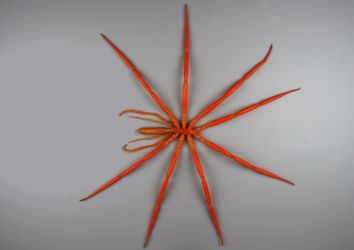
Gaint Sea Spider
These animals make up for the small size (a giant compared with other spiders) of their bodies by accomodating vital organs such as gonads in their long legs. They feed upon corals and other sessile organisms, sucking up their contents through their enormous proboscis. They can grow upto 1 foot.
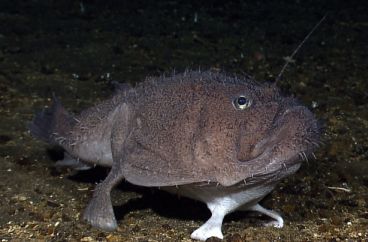
Unidentified deep sea fish
This curious creature, seen in Indonesian waters in the Sangihe Talaud Region, has not yet been definitively identified by scientists.
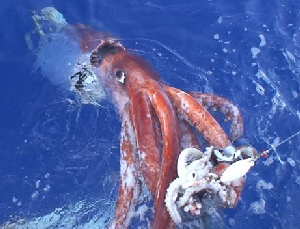
Giant Squid
Giant squid, once believed to be mythical creatures, can grow to a tremendous size. Recent estimates put the maximum size at 13 m (43 ft) for females and 10 m (33 ft) for males. The male of the species has a penis, of over 3 ft (90 cm) in length, which extends from inside the animal's mantle and apparently is used to inject sperm-containing packets into the female squid's arms.
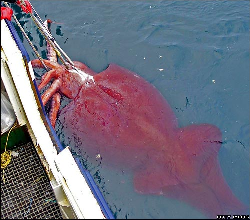

Colossal Squid
The Colossal Squid is believed to be the largest squid species. Though it is known from only a few specimens, current estimates put its maximum size at 12 - 14 metres (39 - 46 feet) long, based on analysis of smaller and immature specimens, making it the largest known invertebrate.